
Common – Common Ground for Sustainable Landscape Futures
The main goal is to develop and test commons-based models for democratic, citizen-driven landscape transformation. Øm Folkefælled serves as a living lab to integrate local democracy, culture, nature restoration and collaborative governance.
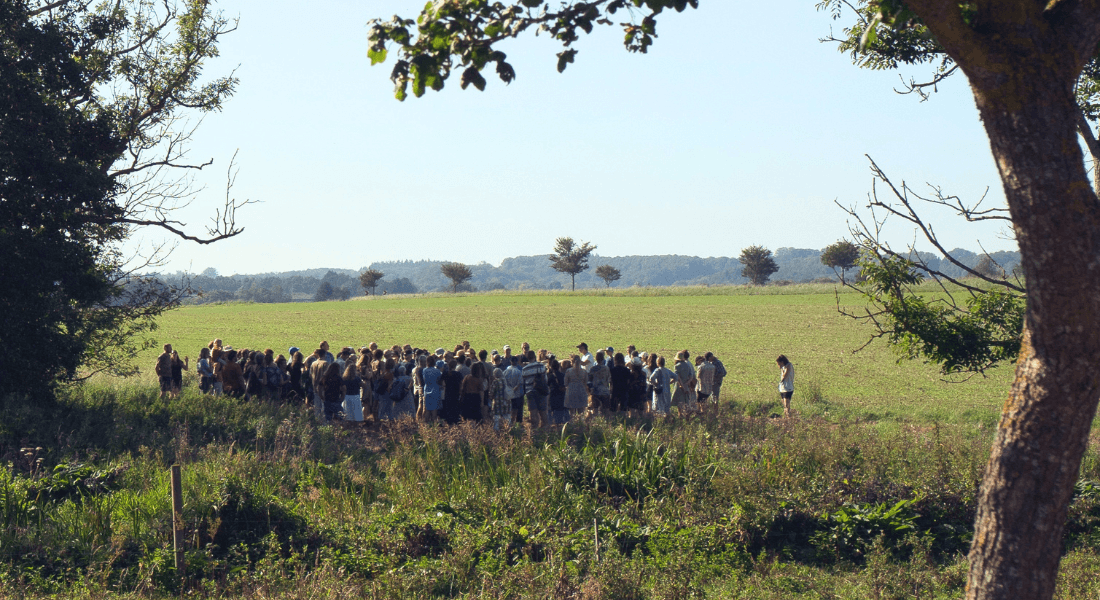 The transition towards sustainable landscapes requires new forms of democratic governance that can bridge ecological restoration, local communities and public planning. This project investigates how the commons can provide such a framework by combining research and practice in a living lab. Using Øm Folkefælled as its evolving empirical case in combination with the ongoing cases, Skovgro, Alling and Halkær, the project explores how citizen-driven landscape transformation can strengthen democratic participation, foster collaboration across civil society, landowners and public authorities, and generate transferable knowledge for future landscape governance. The project contributes both theoretical insights and practical models for democratic sustainability.
The project investigates how democratic sustainability can be strengthened through commons-based landscape governance in the green transition. As climate adaptation, biodiversity restoration and renewable energy reshape rural landscapes, existing governance models often struggle to balance competing interests and sustain long-term public engagement. The project explores how the commons can provide a democratic framework for collective stewardship, shared decision-making and landscape transformation.
Combining perspectives from landscape architecture, planning, political theory, commons studies and sustainability science, the research develops new conceptual and practical approaches to democratic landscape governance. It examines how collaborative governance can support ecological restoration while strengthening civic participation, place attachment and social cohesion, with design acting as a bridge between ecological processes, local knowledge and public planning.
Empirically, the project draws on the existing cases of Skovgro, Alling and Halkær, alongside Øm Folkefælled as a living laboratory where research and practice are developed through co-creation with citizens, landowners, municipalities, civil society organisations and other stakeholders. Using case studies, participatory design and comparative analysis, the project documents governance processes, evaluates outcomes and develops transferable methods for democratic landscape transformation.The project advances international research on the commons, participatory governance and landscape democracy by generating evidence-based knowledge and practical models for more resilient, inclusive and legitimate landscape planning and governance in Denmark and beyond.
The project brings together researchers and practice partners to develop and test new approaches to democratic landscape governance. The research is led by the University of Copenhagen, where an interdisciplinary team contributes expertise in landscape architecture, planning, democratic governance, commons theory and sustainability science. The researchers are responsible for the project's conceptual framework, comparative analyses, methodological development and scientific dissemination.
The primary practice partner is Lejre Landsbyer, which leads the development of Øm Folkefælled as the project's central living laboratory. Through its local networks, Lejre Landsbyer facilitates collaboration among citizens, landowners, farmers, civil society organisations and public authorities, creating the conditions for experimenting with commons-based landscape governance. Øm Folkefælled is established at Øm Klostergaard, which provides the land and is a key local partner in the long-term development of the site. Godis Grønt, which rents agricultural land from Øm Klostergaard, participates as a local actor through its regenerative vegetable production and involvement in the collaborative development of the landscape.
The project also draws on three established commons initiatives—Skovgro, Alling and Halkær—as comparative action-learning cases. These partners contribute practical experience with community-based landscape stewardship and enable comparison of governance models, organisational forms and local contexts.
Lejre Municipality contributes local planning perspectives and participates in selected activities, while Rådet for Grøn Omstilling (RGO) contributes expertise in green transition, policy development and public engagement.
The collaboration is organised as a process of co-creation in which researchers and practice partners jointly develop questions, test governance approaches and evaluate outcomes. This continuous exchange ensures that research is grounded in practice while generating transferable knowledge and models for democratic landscape transformation.
Researchers
| Name | Title | Phone | |
|---|---|---|---|
| Anton Bech Jørgensen | PhD Fellow | +4535336958 | |
| Ellen Braae | Professor | +4535331792 |
Funded by:

Common – Common Ground for Sustainable Landscape Futures has received a three year funding from Velux Foundation.
Project: Common – Common Ground for Sustainable Landscape Futures
Period: Jan 2026 - Feb 2029
Contact
Ellen Braae
E-mail: embra@ign.ku.dk
Mobil: +45 29 17 71 17