
|
|
Søren Brander |
Enzyme Ecology
Our research is focused on the enzymes that catalyse degradation of plant cell walls in nature as well as in industrial biorefineries.
The aim is to both understand the molecular mechanisms and the systems in which the enzymes work. Our laboratories are equipped with specialised instruments that allow for study the role of oxygen in the degradation processes.
Special attention is given to enzymes called lytic polysaccharide monooxygenases (LPMOs). These enzyme are mononuclear copper enzymes that use oxygen-species for catalysis.
LPMOs are likely to have several functions in biology and are important for saprotrophic fungal lifestyle. Importantly, they initiate degradation of cellulose by cleaving glycosidic bonds at places that are not accessible cellulose hydrolases.
Ongoing Projects
Crypto (2022-2026)
NNF Synergy grant "Mechanisms of lytic polysaccharide monooxygenases in fungal pathogenesis: directing polysaccharide structure and metabolism in Cryptococcus neoformans". NNF grant number NNF21OC0070070.
Contact: Søren Brander
OxyMiST (2021-2028)
Oxygen Constraints on Microbial Secretomes during Plant Cell Wall Turnover
Contact: Søren Brander
Completed Projects
HOPE (2017-2022)
Harnessing the Oxidative Power of Enzymes
Contact: Søren Brander
Master projects
Every year we develop a list of project ideas. You can use the Thesis Idea Catalogue to get inspiration for you own project, or formulate your own project. You are always welcome to come by our offices to discuss your ideas.
Bachelor projects
We are always looking for students who want to try out production, purification, and characterization of enzymes. These projects offer a great opportunity to develop a range of laboratory skills, providing tangible results, such as colonies on a plate, bands on a PAGE-gel, and color formation from enzymatic assays.
In the Enzyme Ecology group, our research focuses on enzymes that are working on natural polymers, and each project will work towards an experiment that test such an activity on a heterogeneous (dirty) sample. Join us to gain valuable hands-on experience and contribute to meaningful research.
Examples of enzymes:
- LPMOs that oxidize and degrade insoluble fibers (key enzymes in recycling of biomass in nature and in industrial setting)
- Glucose oxidases, unexpectedly found in anaerobic environments
- Glycan hydrolases that degrade glycan matrix in biofilms
- Carbonic anhydrases, which can capture CO₂ and convert it to bicarbonate
How to find us
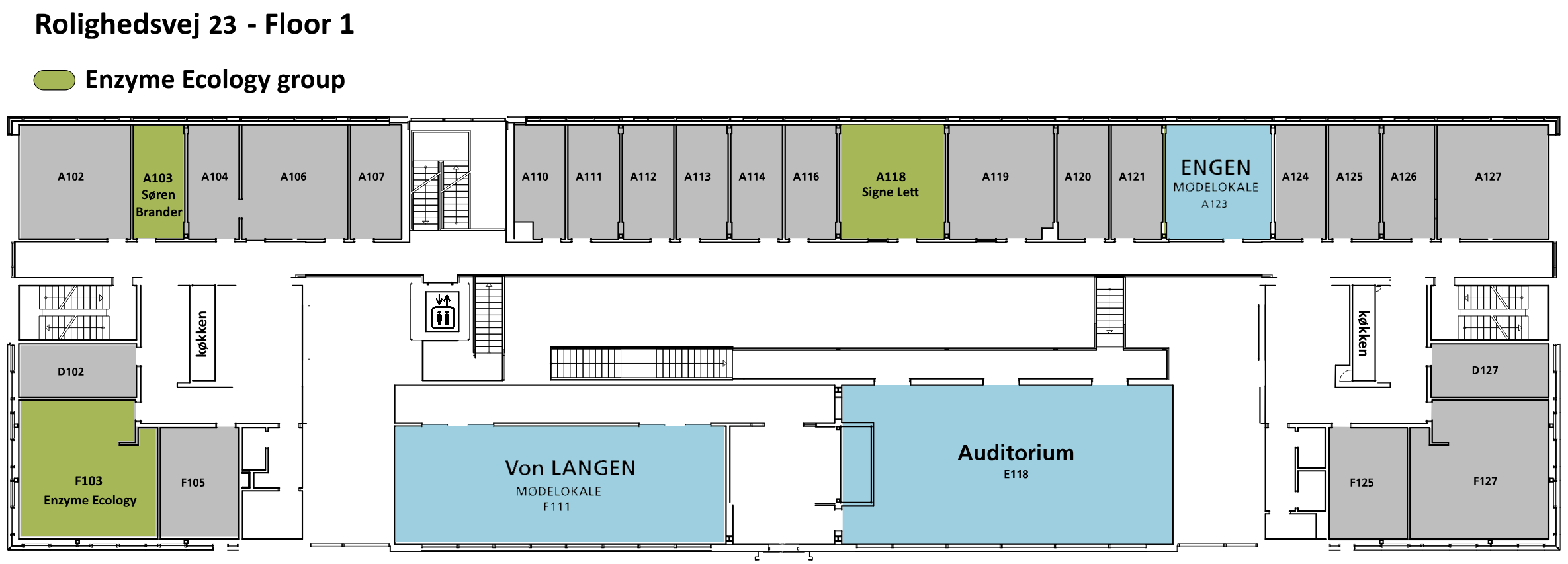 Please click here or on the image to view a larger format
KUnet Student Information
On this link you can find useful student information about projects, thesis contracts and other
Sphagnum peat: Chemical environment, composition and enzymatic degradation
Jonas Thomsen (2025)
Read abstract here
Inhibition of Lytic Polysaccharide Monooxygenases by Plant Extracts
Radina Tokin (2021)
Read abstract here
On the Histidine Brace in Redox Enzymes and Chaperones
Johan Ørskov Ipsen (2021)
Read abstract here
Researchers
This content is temporarily unavailable because the system it is fetched from cannot be reached. The rest of the site works as usual.
Status is available on the operating status page.
