
Landscape Technology
Improved Construction Technologies
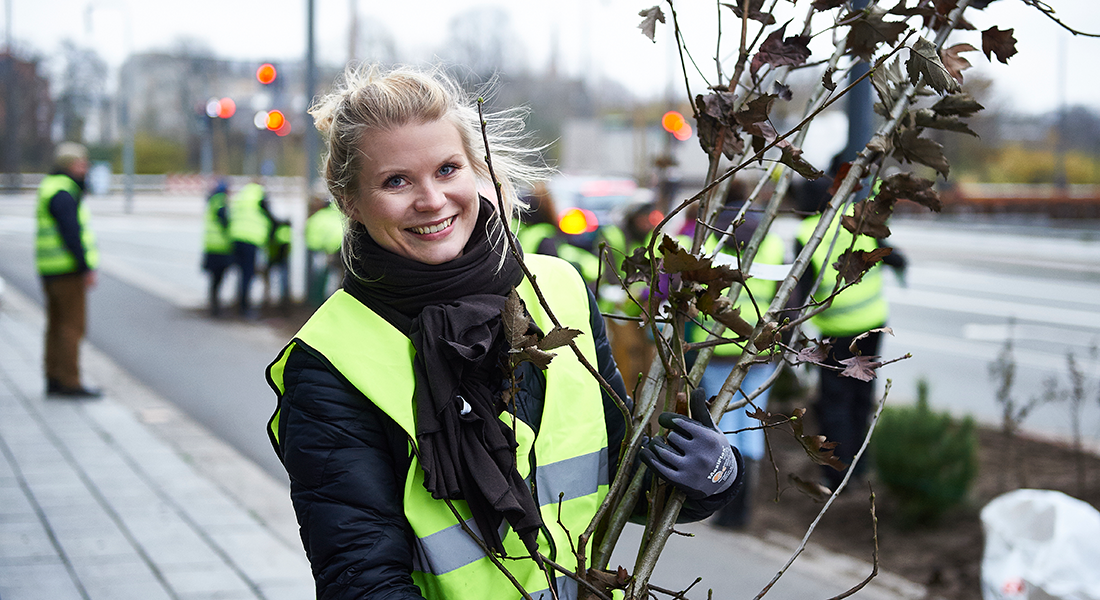
Landscape Technology research aims to expand the foundation for landscape architecture. It is about improved construction technologies and new nature-based infrastructure services. Examples of targeted fields are dynamics and establishment of vegetation; climate adaptation, water treatment, and erosion control; and enhancement of urban nature. We combine a wide range of disciplines including among others landscape architecture, environmental chemistry, horticulture, urban planning, biology, civil engineering, GIS and modelling.
Sustainable Development
The overarching purpose of our research is to combine natural sciences with urban landscape design to promote sustainable urban development. As evident from the list of publications and projects, our research spans from planning and management of urban landscapes, including coastal landscapes, to the innovation and documentation of specific techniques and methods for sustainable development.
The Landscape Technology Research Group works with questions like
- How can we develop landscape architecturally interesting and sustainable planting concepts that work on both planning, projecting and management levels?
- Can the urban water infrastructures be rethought in such a way that the cities both become robust towards both extreme rain and drought and are strengthened with regards to city life, biodiversity and recreational opportunities?
- How are operations and management of green spaces organized, and what changes and innovations are currently happening? How is the cooperation between management methods, the organizational reality and the green Spaces?
Selected projects
- Green Climate Screen for handling roofing water via evaporation Contact: Marina Bergen Jensen
- Space for resilience – how do we plan for stormwater, biodiversity and recreation to increase urban resilience (SPARE). Contact: Marina B. Jensen and Emilia D. Lausen
- Monitoring Cloudburst Roads – permeable pavements Contact: Jan Støvring
- Greenstorm - An EU research project under the Driving Urban Transition programme focusing on green solutions. Contact: Marina B. Jensen and Emilia D. Lausen
- INNATURE Contact: Emilia D. Lausen and Marina B. Jensen
- INTERLAYER A project in the Water4All-program. More information: interlayer_JTC_2022_W4A.pdf Contact: Marina B. Jensen.
- Regions 4 Climate. Contact: Mark Randall.
Collaboration and Networks
We collaborate with Department of Plants and Environment, Danish Technological Institute, GEUS, municipalities, companies and a couple of Universities.
We are for instance a part of the Danish network of climate change adaption: Det Nationale Netværk for Klimatilpasning
Beplantningsdesign (BA)
Planter og Teknologi 1 (BA)
Planter og Teknologi 2 (BA)
Design by Management (MS)
Urban Ecosystems (MS)
Klimatilpasning og grøn teknologi (Professionsbachelor)
Urban Water Management (Sino-Danish Center)
Continuing education: Water Sector Governance and Operation (WSGO) (Danida Fellowship Centre)
See the research group's Danish site Landskabsteknologi
Members of the Research Group
| Name | Title | Phone | |
|---|---|---|---|
| Search in Name | Search in Title | Search in Phone | |
| Emilia Danuta Lausen | Assistant Professor | ||
| Hanna Allesøe Hansen | Enrolled PhD Student | +4535322338 | |
| Jan Støvring | Senior Research Consultant | +4535331837 | |
| Marina Bergen Jensen | Professor | +4535331790 | |
| Mark Taylor Randall | Academic Research Officer | ||
| Ole Fryd | Associate Professor | +4520984243 | |
| Saleem Samuda | PhD Fellow |
Head of Research Group
 Marina Bergen Jensen
Professor
E-mail: mbj@ign.ku.dk
Tel.: +45 35331790
Mobile: +45 27244447
Pressurized NBS for stormwater management
With the Green Climate Screen roof runoff evaporates. See how in the video. The clothes line effect is important. Read more in the American journal COMSOL.
Cities need protection against rising sea water
Storm surges and sea rise will potentially affect more than half of Denmark's 100 largest cities. Researcher Ole Fryd visits in this video Amager Strandpark and presents four fundamental models for the protection of cities, roads and recreational facilities along the coast.
Permeable asphalt helps prevent flooding
How does permeable asphalt work in practice? Senior Consultant Jan Støvring is investigating a project in Frederiksberg. In this video he talks about the preliminary results, which, among other things, prove that it is important to clean the roads thoroughly each or every other year.